

Most manufacturing still runs linear: take a raw material, make something with it, and throw away whatever’s left over. Circular economy manufacturing breaks that line into a loop instead. It treats “waste” as a resource for the next product, not something to landfill. That shift matters far beyond heavy industry – it’s reshaping how everyday products like cleaning chemistry get made too.
What it actually means
At its core, a circular model asks one question before anything else: what happens to this material after its first use? A linear model has one answer; it becomes waste. A circular model has several: it gets recovered, reprocessed, and turned into a new ingredient or product. The goal isn’t just less waste, it’s designing the waste out from the start, so the “leftover” from one process becomes the raw material for the next.
For cleaning specifically, that usually means rethinking where the active ingredients come from. Traditional surfactants are typically derived from petroleum. A circular approach looks for a different source – ideally one that’s already a byproduct of something else, rather than something pulled fresh from the ground.
How it shows up in our Natural Line
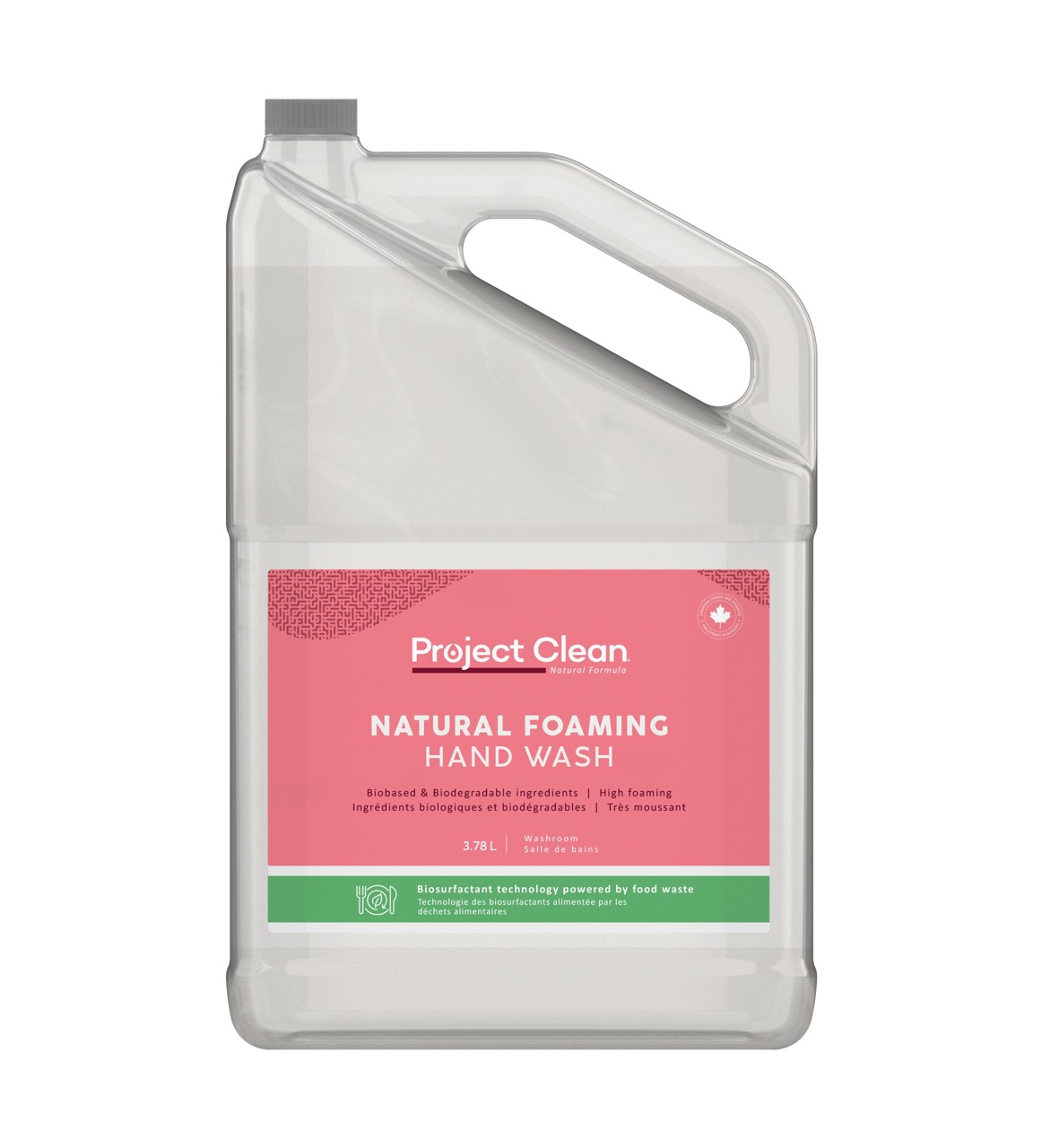 This is exactly where our partnership with Dispersa, a Canadian biotech company comes in. Dispersa developed a way to turn food waste into a high-performing biosurfactant – one of the cleaning ingredients at the core of our Natural line. Instead of starting with petroleum, the process starts with food waste that would otherwise be discarded and converts it into an ingredient that cleans as well as (or better than) the conventional alternative.
Natural Foaming Hand Wash for example, the newest product built on this technology, is a good example of what that looks like in practice. It’s a high foaming, gentle hand soap for high-traffic facilities, and its core ingredient traces back to food waste rather than crude oil. The performance doesn’t change. The supply chain does.
That’s the real test for any circular-economy claim: does the alternative material actually perform, or does it ask the customer to accept a tradeoff? With a food-waste derived biosurfactant, the answer so far has been no tradeoff – same cleaning power, different starting point.
Why it matters for facility buyers
Procurement teams increasingly have to answer for where their supplies come from, not just how well those supplies work. A circular supply chain gives you a concrete answer beyond a general sustainability statement: this ingredient comes from food waste, not petroleum, and here’s the company that makes it happen. That’s a specific, verifiable story, not just a green label on a bottle.
It also tends to track with genuine innovation rather than a marketing repackage of an old formula. Building a new ingredient supply chain from scratch takes real R&D. A circular story is usually a sign that a supplier has actually invested in the chemistry, not just the packaging.
The bottom line
Circular economy manufacturing isn’t an abstract industry trend for us – it’s the supply chain behind our Natural line, starting with our partnership with Dispersa and showing up most recently in Natural Foaming hand Wash. The waste stream becomes the resource, and the resource becomes real cleaning performance for your facility.
Explore the full Natural line and see where a circular supply chain fits into your facility’s cleaning program.
